
Reading Time: 8 Minutes
What Breast Cancer Awareness Month Doesn't Tell Us

Every October, pink ribbons appear on everything from clothing and cosmetics to food packaging and household products. Businesses launch special collections. Organizations promote fundraising campaigns. Social media fills with reminders about breast cancer awareness, screening, and the importance of early detection, then November arrives.
The pink merchandise starts disappearing, the campaigns quiet down, and we move on to the next cause, the next health trend, and the next thing we're told to pay attention to. Breast health doesn't follow a marketing calendar though.
Breast cancer affects individuals and families throughout the year, and understanding it requires more than wearing a ribbon or scheduling a screening. It requires honest conversations about prevention, the limitations of screening, the potential harms of testing, and the commercial interests that sometimes become intertwined with our health.
It also requires room for questions.
Can a company genuinely support breast cancer awareness while selling products that may contribute to cancer risk?
Does finding cancer earlier always mean a better outcome?
What happens when dense breast tissue makes a mammogram less effective?
Why do conversations about detecting disease often receive more attention than conversations about reducing risk?
Pink ribbons don't automatically mean a good cause

Let's start with the pink ribbon itself. Breast Cancer Awareness Month has helped bring attention to a disease that affects millions of people. Fundraising, research, education, and support services can make a meaningful difference. a problem. The problem begins when awareness becomes a marketing strategy that benefits a company more than it benefits the cause.
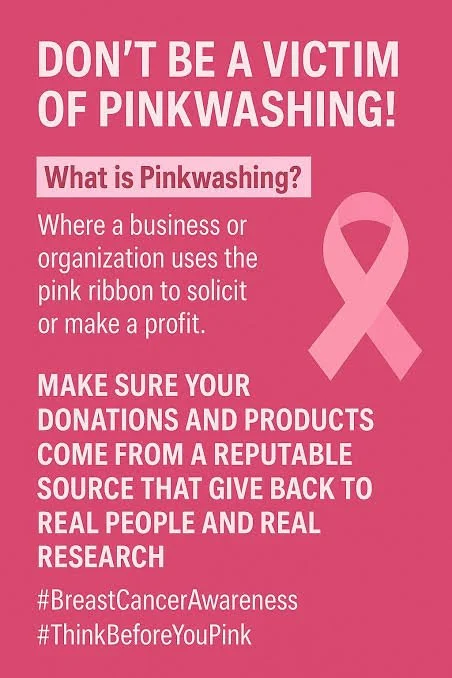
This practice is often called pinkwashing.

Pinkwashing can occur when businesses use breast cancer awareness campaigns to sell products or improve their public image while making little meaningful contribution to research, patient support, or prevention. It becomes particularly troubling when a company promotes a product through breast cancer messaging while the product itself raises legitimate health concerns.
Consider what happens when a product is wrapped in pink packaging and accompanied by a charitable message.
Consumers may feel that purchasing it is an act of support. The ribbon creates an emotional connection, and the charitable message can make the purchase feel more meaningful than an ordinary transaction.
But how much money is actually donated? Where does it go? Is the donation capped? Does the company clearly explain the arrangement? And does its broader business conduct align with the health message it is promoting?
These are reasonable questions, not cynical ones.
A company might genuinely donate to a worthwhile organization and still use the campaign primarily to increase sales. Both things can be true.
“The presence of a pink ribbon tells you that a campaign is associated with breast cancer awareness. It does not, by itself, tell you whether the product is healthy, whether the donation is substantial, or whether the campaign meaningfully advances prevention or treatment.”
Before purchasing something because it supports breast cancer awareness, look at the details.
What percentage of the purchase price is donated?
Is there a maximum donation amount?
Which organization receives the money?
How will the funds be used?
Does the product contain something that could contribute to a health condition?
Does the company make other products or engage in business practices that deserve scrutiny?
You can also support breast cancer research and patient services directly, without purchasing a product you don't need.
The point isn't to dismiss every pink ribbon campaign. It's to stop treating marketing as proof of meaningful action.
Early detection is not the same thing as prevention
This distinction deserves far more attention.
Prevention and early detection are often discussed together, but they serve different purposes.
“Prevention focuses on reducing the likelihood that a disease develops. Early detection focuses on identifying disease that is already present, ideally before it causes symptoms.”
Neither approach guarantees an outcome, and both have important roles in healthcare.
Mammography is a screening tool. It uses low dose X-rays to look for changes in breast tissue that could indicate cancer, sometimes before a lump can be felt.
Finding certain cancers at an earlier stage can make treatment more effective and reduce the risk of dying from breast cancer. Evidence supports mammography as an important screening tool for appropriately selected populations.
But a mammogram does not prevent cancer from developing.
It does not eliminate the underlying biological processes that lead to cancer. It does not guarantee that a cancer will be found. And it cannot guarantee that a cancer detected early will never become aggressive or spread.
This distinction matters because a culture focused heavily on screening can unintentionally leave people with the impression that getting tested is the primary thing they need to do to protect their health.
Screening is one part of the picture. Understanding risk, knowing your family history, addressing modifiable risk factors where possible, and seeking appropriate medical care are also important.
There is a caveat worth emphasizing, prevention is not entirely within an individual's control, and breast cancer can develop in people who make healthy lifestyle choices. Genetics, age, reproductive history, environmental exposures, and other factors all influence risk.
We should never imply that someone caused their own cancer by failing to eat well enough, exercise enough, or follow a particular wellness routine.
Instead, the question should be this:
How can we give people a more complete understanding of breast health, including both the role of screening and the opportunities and limitations of risk reduction?
That conversation should happen throughout the year, not just during awareness month.
Mammograms have benefits,limitations and potential harms.
Mammography is not a perfect test.
Like every screening tool, it involves trade offs. Understanding those trade offs helps people make more informed decisions about whether, when, and how often to be screened.
In the United States, the U.S. Preventive Services Task Force recommends screening mammography every two years for women ages 40 through 74 who are at average risk. People with symptoms, a personal history of breast cancer, certain genetic risk factors, or other high risk circumstances may need a different approach.
Recommendations can differ among professional organizations, and individual risk matters.
So what should we understand about mammography?
False positive results
A false positive occurs when a screening result looks suspicious but subsequent evaluation does not find cancer.
This may lead to additional mammograms, ultrasound, MRI, or a biopsy. Even when the final result is benign, the process can involve expense, discomfort, uncertainty, and significant anxiety.
False positives are more common in certain groups, including people with dense breasts and those undergoing their first screening when prior images are unavailable for comparison.
An abnormal mammogram does not mean someone has cancer. It means further evaluation may be needed.
False negative results
A false negative occurs when a mammogram does not identify a cancer that is actually present.
This is one reason screening cannot provide a guarantee of safety. A person may receive a normal result and still develop symptoms or have a cancer that was not visible on the images.
Dense breast tissue makes this limitation especially important.
A new lump, nipple discharge, skin dimpling, a newly inverted nipple, or another persistent breast change deserves medical evaluation even if a recent mammogram was normal.
Overdiagnosis and Overtreatment
This happens when screening identifies a cancer that would never have caused symptoms or shortened a person's life during their lifetime.
There is no way to know with certainty which individual screen detected cancers would have remained harmless. As a result, some people may undergo surgery, radiation, medication, or other treatment for a cancer that would not otherwise have affected them.
This is not the same as saying that cancer treatment is unnecessary in general. Many breast cancers are dangerous and require treatment. The challenge is that screening cannot always distinguish cancers that will progress from those that will not.
Overdiagnosis is a recognized concern in cancer screening, although estimates vary depending on the population studied, the screening program, and the methods used.
Radiation exposure
Mammograms use ionizing radiation, which can damage DNA. The radiation dose from an individual mammogram is low, and the potential risk from this exposure is considered small.
Repeated exposure over time is one reason radiation is included in discussions of screening benefits and harms.
The U.S. Food and Drug Administration and other health authorities conclude that the benefits of appropriately performed mammography outweigh the radiation risks for recommended screening populations.
The more useful question is how to balance the potential benefits and harms for an individual, taking their age, risk factors, breast density, preferences, and screening history into account.
So, are mammograms more harmful than helpful?
The evidence does not support a blanket conclusion that mammograms cause more harm than good for everyone.
For women ages 40 through 74 at average risk, the USPSTF concludes that biennial screening has a moderate net benefit.
At the same time, screening is not harmless, and the benefits and harms are not identical for everyone.
People deserve to understand both sides of that equation. They should be able to ask questions about their individual risk, screening interval, breast density, and the likelihood of additional testing without being made to feel irresponsible for asking.
The goal is neither blind acceptance nor blanket rejection. It is informed decision making.
Are there alternatives to mammograms?
There are other breast imaging methods, but they do not all serve the same purpose, and they are not exactly interchangeable. *This is not medical advice, please coordinate with your physician or naturopath about what option is best for you
Some are used in addition to mammography. Others are primarily used to investigate a symptom or an abnormal screening result.
Here are the main options worth knowing about: Those in bold have been explained below
Breast self awareness/self exam
Clinical Breast exam
QT Imagine ( 3D Transmission Ultrasound)
Koning Breast CT ( KBCT)
Breast MRI
Contrast enhanced Mammography (CEM)
Molecular Breast Imaging (MBI)
Thermography
Breast MRI
Magnetic resonance imaging uses a strong magnetic field and radio waves to create detailed images. It does not use ionizing radiation.
Breast MRI can detect some cancers that are not visible on mammography. It is commonly used alongside mammography for people at high risk of breast cancer, including certain people with inherited genetic variants or a sufficiently high calculated lifetime risk.
MRI can also be considered in some circumstances involving dense breasts.
However, MRI can produce false positive findings, lead to additional procedures, require contrast agents, and involve substantial costs. Whether it is appropriate depends on the person's risk and clinical circumstances.
MRI is not automatically a better replacement for mammography for every person.
Breast ultrasound
Ultrasound uses sound waves rather than ionizing radiation.
It can help evaluate a lump and may be used as supplemental screening for some people with dense breasts.
Ultrasound can identify some cancers that are not visible on mammography, but it can also produce false positive findings and lead to additional testing or biopsies.
Importantly, evidence remains insufficient to determine the overall balance of benefits and harms of supplemental ultrasound or MRI after a normal mammogram for all women with dense breasts.
The decision should be individualized.
Contrast enhanced mammography
Contrast enhanced mammography uses contrast material and X-ray imaging to provide additional information about breast tissue.
It may be useful in certain diagnostic or screening situations, depending on the person's risk, the facility, and clinical guidance.
It still involves radiation and contrast material, so it is not a risk free substitute.
Thermography
Thermography uses infrared imaging to measure patterns of heat at the body's surface.
Some wellness businesses market it as a painless, radiation-free alternative to mammography. However, the U.S. Food and Drug Administration states that thermography has not been shown to be an effective standalone method for breast cancer screening.
It should not be presented as an equivalent replacement for mammography.
Choosing thermography instead of an established screening method could delay the detection of cancer.
Clinical breast examinations and Breast self awareness
A clinical breast examination involves a healthcare professional examining the breasts and surrounding areas for changes.
Breast awareness means knowing what is normal for your body and seeking medical evaluation when something changes.
Both can have a role in recognizing symptoms, but neither is considered an adequate standalone replacement for recommended mammography screening in average risk populations.
Being aware of your body is important. It is not a guarantee that a cancer will be detected early.
What about avoiding screening altogether?
Some people may decide against screening after considering the potential benefits and harms, their health circumstances, and their personal values.
Others may reasonably prefer to follow recommended screening guidance.
The important thing is that the decision be informed by reliable evidence rather than fear based marketing, unsupported claims, or the assumption that a normal screening result guarantees that cancer is absent.
If you have a breast symptom, don't treat a screening decision as a substitute for diagnostic evaluation.
A new or persistent lump, skin change, nipple change, or unusual discharge warrants medical attention regardless of when your last mammogram occurred.
If early detection matters, why isn't prevention discussed more?
This is a question worth asking without assuming that screening and prevention are competing priorities.
They are not.
Screening is intended to find certain cancers earlier. Risk reduction aims to lower the likelihood of developing cancer in the first place. Both can contribute to better health outcomes.
There are established breast cancer risk factors that people cannot change, including age and certain inherited genetic variants. Other factors may be modifiable, although reducing risk does not guarantee that cancer will not develop.
Evidence supported areas worth discussing with a healthcare provider include:
Alcohol consumption, which is associated with increased breast cancer risk.
Physical activity and maintaining a healthy weight, particularly after menopause.
Certain hormone therapies, whose effects on breast cancer risk depend on the type, combination, duration, and individual circumstances.
Family history and inherited genetic risk.
Reproductive and other biological factors that influence risk.
This is not a checklist that guarantees prevention. It is a starting point for a more complete discussion of health.
Nutrition and lifestyle can be part of that conversation, but no particular diet, supplement, detox, or natural protocol has been established as a way to prevent all breast cancers.
It is also important not to turn risk reduction into blame. People who eat well, exercise, avoid alcohol, and make thoughtful health choices can still develop breast cancer.
The more useful public health conversation would give people practical, evidence informed information about risk while acknowledging what remains beyond individual control.
We can encourage appropriate screening and still ask whether we're doing enough to understand risk, support prevention research, and improve access to effective treatment.
One does not cancel out the other.
Here are some Natural Ways you can optimize your breast health:
Wear loose fitting cotton bras - Many modern made bras have underwires or contain elements that cause restriction around the breasts, arms and back. If you are noticing pressure marks when you remove your bra it would be good to evaluate the fit. There are also many synthetic materials in most bras nowadays that are absorbed through the skin and can contain harmful materials. Aim to get the highest cotton percentage as possible in the bras you choose.
Know your breasts - If you are still menstruating it matters more when you do a self breast exam as your luteal phase can contribute to different textures, fibrocystic breast flares and swelling. Examine your breasts at least 3 times a months, after your period, midway through your cycle and leading up to your period. This will give you a healthy idea of how they feel from time to time. The shower is the easiest place to do it because you can glide over your skin easier.
Reevaluate Cosmetics - Look into the cosmetics you are using to make sure they don’t contain any harmful ingredients that could contribute to a health condition
Eat nutrient dense foods
Greatly limit or eliminate alcohol
Manage stress
Movement everyday
Eat hormone free meats
Replenish probiotics everyday
Hydrate well
Breastfeed
Consume Fermented foods
Aim for 35 grams of fiber per day
Reevaluate hormone therapy
Promote daily bowel movements by eating well and taking care of your digestive health
Know your hormone levels
Let's make breast health a year round conversation
Breast Cancer Awareness Month can serve a useful purpose. It can encourage people to learn about breast cancer, support research, and seek appropriate medical care.
But awareness should be the beginning of the conversation, not the end.
We can encourage people to make informed decisions without frightening them into a particular choice.
Because breast health deserves more than a pink ribbon, a product promotion, or a reminder to schedule an appointment. It deserves honest information, thoughtful questions, accessible care, continued research, and conversations that continue long after October ends.
Wishing you ongoing wellbeing & managed health,

Sources:
Pinkwashing: Breastcancer.org: What Is Breast Cancer Pinkwashing? — explains cause-related marketing and the questions consumers can ask about pink ribbon campaigns.
Mammography screening benefits and harms: National Cancer Institute: Breast Cancer Screening — covers screening, false positives, overdiagnosis, false negatives, and radiation exposure.
Current U.S. screening recommendations: U.S. Preventive Services Task Force: Breast Cancer Screening — recommends biennial mammography for women ages 40–74 at average risk and discusses the evidence limitations surrounding supplemental imaging for dense breasts.
Dense breasts: National Cancer Institute: Dense Breasts, Common Questions — explains how density affects risk and mammography accuracy, as well as questions about additional screening.
Thermography: FDA: Thermogram No Substitute for Mammogram — explains why thermography is not considered an equivalent standalone screening method.
Mammography's limitations: American Cancer Society: Limitations of Mammograms — covers false positives, false negatives, and the possibility of additional testing.